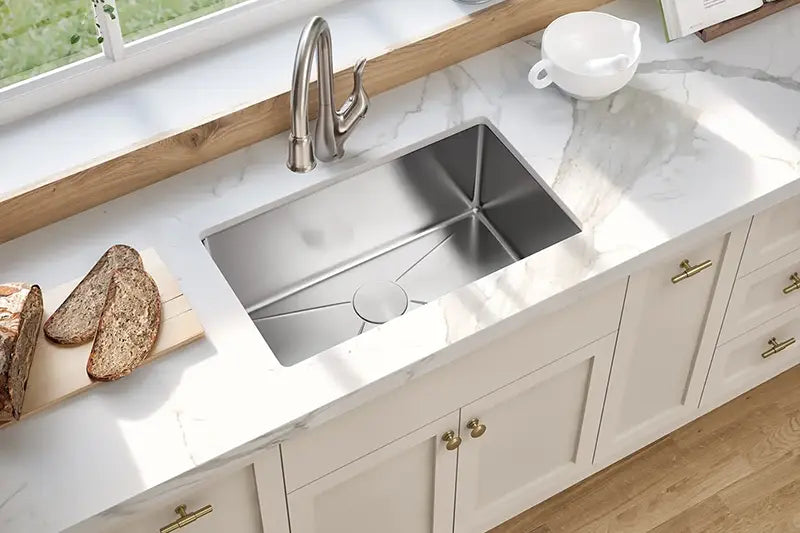

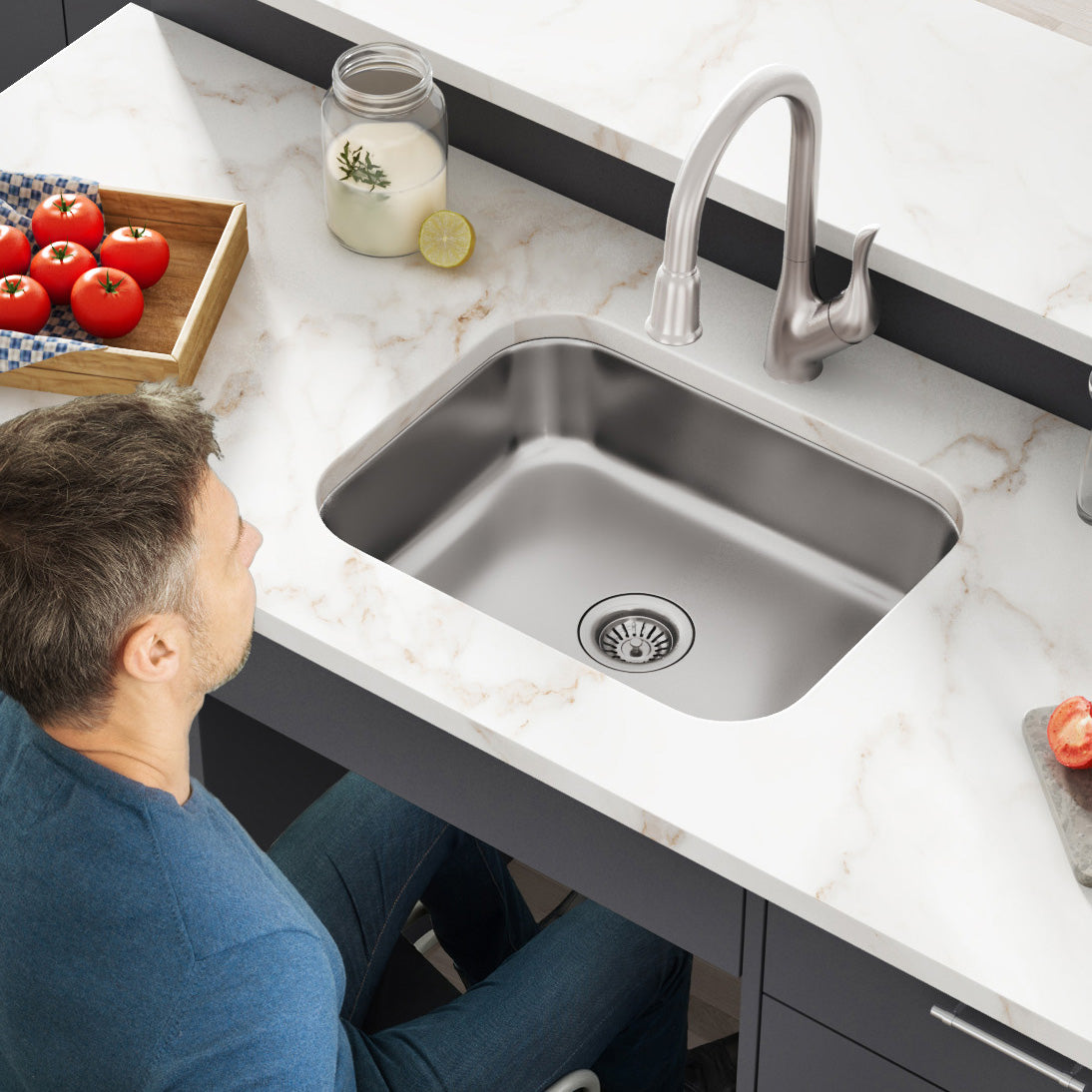



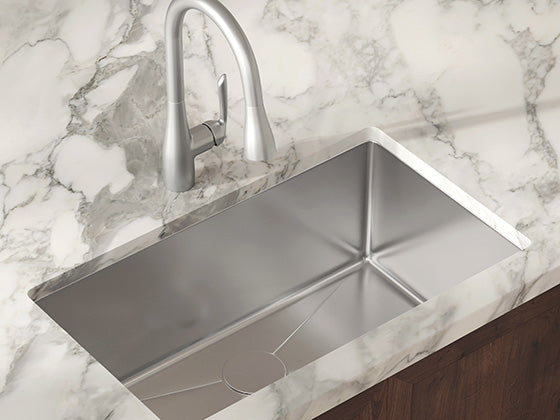
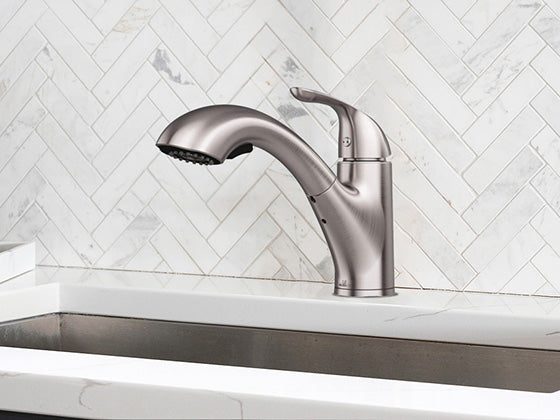

In the case of stainless steel kitchen sinks, most buyers rely on visual appearance and price to make a buying decision. Initially, many stainless steel sinks feature pretty much the same look: shiny, smooth, and clean.
Under that shiny surface is an important detail. It affects how long your sink will resist rust and corrosion: the grade of stainless steel used to make it.
The Hidden Risk: Rust and Corrosion
Customer complaints about rust are among the most common quality issues in kitchen sinks. When rust appears, even as small spots or along seams, it lowers trust in the product. It may also make people think that other materials used in the project are of low quality.
For builders, designers, or purchasing managers, this often leads to expensive call-backs, reputation risk, and logistical headaches. And for the homeowner, a rusting sink means frustration, replacements, and additional costs.

What is the root cause of these problems? Different types of stainless steel materials exist, and some are much better than others.
The Deceptive Look-Alikes
The problem for buyers is that 200-series and 304 stainless steel often look exactly the same out of the box. Without testing, it's nearly impossible to distinguish between them.
Manufacturers produce some 200-series sinks with high standards for welding and polishing. These sinks weigh the same as their higher-quality 304-grade versions, making them hard to tell apart. However, after a few months of use, rust and corrosion will often start showing.
This visual similarity makes cutting corners tempting. Using 201-grade stainless steel can lower material costs by about 25% to 35% compared to 304-grade.
Understanding Stainless Steel Grades: 200 vs. 304 vs. 316
Stainless steel is not just one material. It is a group of steel alloys made to resist corrosion by adding chromium (Cr) and, in higher grades, nickel (Ni). Cheaper options replace corrosion-resistant metals with less expensive ones like manganese (Mn). This change affects long-term performance.

Let’s look at the most common grades used in sink manufacturing:
Premium sinks, marine or outdoor environments
When new, the 200 series stainless steel, especially 201 and 202, looks like 304. However, it has much less nickel and more manganese. This substitution lowers cost but also reduces corrosion resistance, especially in environments with high moisture, salt, or acidity. On average, 200-series stainless steel can reduce material costs by an estimated 25%–35% compared to 304-grade.
The Science Behind the Grades
 |
Nickel (Ni)Nickel (Ni) is a key alloying element that improves resistance to corrosion, especially against acidic and saline environments. It also enhances the stability of the passive chromium oxide film that protects the steel surface. |
 |
Chromium (Cr)Chromium (Cr) is essential for forming that protective oxide layer that makes stainless steel "stainless". |
 |
Manganese (Mn)Manganese (Mn) can partially replace nickel. However, it does not create the same stable and corrosion-resistant structures. In some cases, it can even speed up rusting. |
 |
Molybdenum (Mo)Molybdenum (Mo), present in 316-grade, further enhances resistance to pitting corrosion—especially in marine environments. |
This means that 304 and 316 stainless steel last longer. They are more resistant to the types of corrosion found in kitchens.

Quality Testing: How to Spot the Difference
Because visual inspection won’t reveal stainless steel grade, chemical spot testing is a key tool in material verification. These tests work by reacting with the surface of the steel and changing color based on its composition.
Time-Based Color Testing

One common method uses a chemical reagent applied to the steel surface. Depending on the grade:
-
201 stainless reacts quickly, turning red or brown within 5–50 seconds
-
202 may react in around 60 seconds
-
304 stainless reacts slowly, if at all—often requiring 2–3 minutes for even a faint color change
-
316 stainless typically shows no visible change within that time frame
These tests rely on the oxidation of manganese ions—more present in 200-series steels. The faster the color shift, the lower the quality of the stainless.
Reagent Composition (Simplified)
While many reagent formulas are not public, effective stainless steel tests usually include:
-
A dilute acid (like nitric or sulfuric acid) to break the passive layer
-
A mild oxidizer to react with surface metal ions (e.g. ferric chloride)
-
Optional dyes to make the reaction visible
Some high-precision lab methods (like ICP-MS) can determine exact metal content. For QC purposes in sink manufacturing, time-based spot testing is fast and practical.

Note on Spot Rusting in 304 Sinks
Even high-quality 304 stainless can occasionally show surface rust in specific conditions.
-
In zero-radius sinks, sharp corners are harder to drain and may retain moisture longer. In some cases, the welds in these corners slightly alter surface properties and reduce passivation.
-
Exposure to high salt content or harsh chemicals (like bleach or drain openers) can create oxidation marks.
Surface stains are not material failures and are easy to clean. A stainless steel cleaner like Bar Keepers Friend will usually restore the surface completely.
How Allora Verifies Stainless Steel Quality
At Allora, we understand that visual quality is only part of the picture. That’s why we test every lot of stainless steel sinks before they enter distribution. Using field spot tests and supplier-grade certifications, we verify:
-
That each batch meets or exceeds 304 stainless steel standards
-
That no 200-series material is used in place of 304
-
That weld seams and corners pass inspection for durability and corrosion resistance
This ensures our sinks offer not just visual appeal, but long-term performance in real-world conditions.

Final Thoughts
Whether you are shopping for a farmhouse sink, workstation sink, ADA-compliant sink, or classic undermount sink, don’t rely on appearance alone. Make sure the supplier uses verified stainless steel and backs it up with consistent testing and transparency.
At Allora, we build our stainless steel sinks to last—and we have the data to prove it. Explore our full collection of stainless steel kitchen sinks to find the right fit for your project.