



Quick Reference
Standard kitchen sink sizes for multifamily projects:
Kitchen sink standard sizes are the dimensional specifications — width, front-to-back depth, and basin depth — that determine how a sink fits a base cabinet, what countertop cutout is required, and whether the sink meets ADA clearance requirements for accessible units.
On multifamily projects, getting the size right at the specification stage prevents cutout rework, cabinet conflicts, and ADA inspection failures across every unit. This reference covers the standard sizes used on apartment, senior living, student housing, and hospitality kitchen projects.
In multifamily construction, "standard" sink sizes are defined by cabinet compatibility and repeatability across units — not by a universal industry size list. The sizes below reflect the widths most commonly specified on commercial and multifamily projects.
Kitchen Sink Size Reference Table
This table maps kitchen sink standard sizes to cabinet compatibility, basin depth (standard and ADA), typical multifamily application, and the corresponding product collection for each size.
| Sink Width | Cabinet Size | Front-to-Back | Standard Depth | ADA Depth | Best Fit | Collection |
|---|---|---|---|---|---|---|
| 23" | 27" base | 18" | 9"–10" | ≈5.5"* | Compact / studio units | 23" sinks |
| 27" | 30" base | 18" | 9"–10" | ≈5.5"* | Standard multifamily | 27" sinks |
| 30" | 33"–36" base | 18"–22" | 9"–10" | ≈5.5"* | Standard multifamily (most common) | 30" sinks |
| 33" | 36" base | 22" | 9"–10" | ≈5.5"* | Class A / premium units | 33" sinks |
*ADA basin depth is not a fixed code maximum. The achievable depth depends on counter height, sink geometry, drain placement, and the resulting knee clearance. The values shown are common design targets used by manufacturers to meet ADA clearance requirements.
Cabinet-to-Sink Sizing Rule for Multifamily Kitchen Layouts
The general rule: the sink width should typically be at least 3" narrower than the outer cabinet width, depending on cabinet construction and mounting method. This leaves approximately 1"–1.5" of clearance on each side for mounting hardware, undermount clips, and installer access.
On multifamily projects where every kitchen uses the same cabinet layout, this rule simplifies sizing to a one-time decision that repeats across all units. The table below maps cabinet widths to recommended sink sizes.
| Cabinet Width (Outer) | Inside Clearance (Approx.) | Maximum Sink Width | Recommended Sink Width |
|---|---|---|---|
| 24" | 22.5" | 21"–22" | 21" or smaller |
| 27" | 25.5" | 24" | 23" |
| 30" | 28.5" | 27" | 27" |
| 33" | 31.5" | 30" | 30" |
| 36" | 34.5" | 33" | 30"–33" |
For undermount installations, always verify the inside cabinet clearance against the sink's outside dimensions — not the nominal size. A sink labeled "30-inch" may have outside dimensions of 30.25" or 29.75" depending on the manufacturer. Confirm with the spec sheet before locking the cutout template.
What Size Kitchen Sink Fits Each Cabinet?

30-inch cabinet: a 27" sink is the standard fit. The cabinet's inside clearance is approximately 28.5", leaving room for mounting hardware on each side.
33-inch cabinet: a 30" sink is the recommended fit. This is the most common pairing on multifamily projects.
36-inch cabinet: a 30" or 33" sink fits, depending on project tier. 30" leaves more under-sink storage; 33" maximizes basin space for premium units.
ADA Kitchen Sink Sizing Considerations
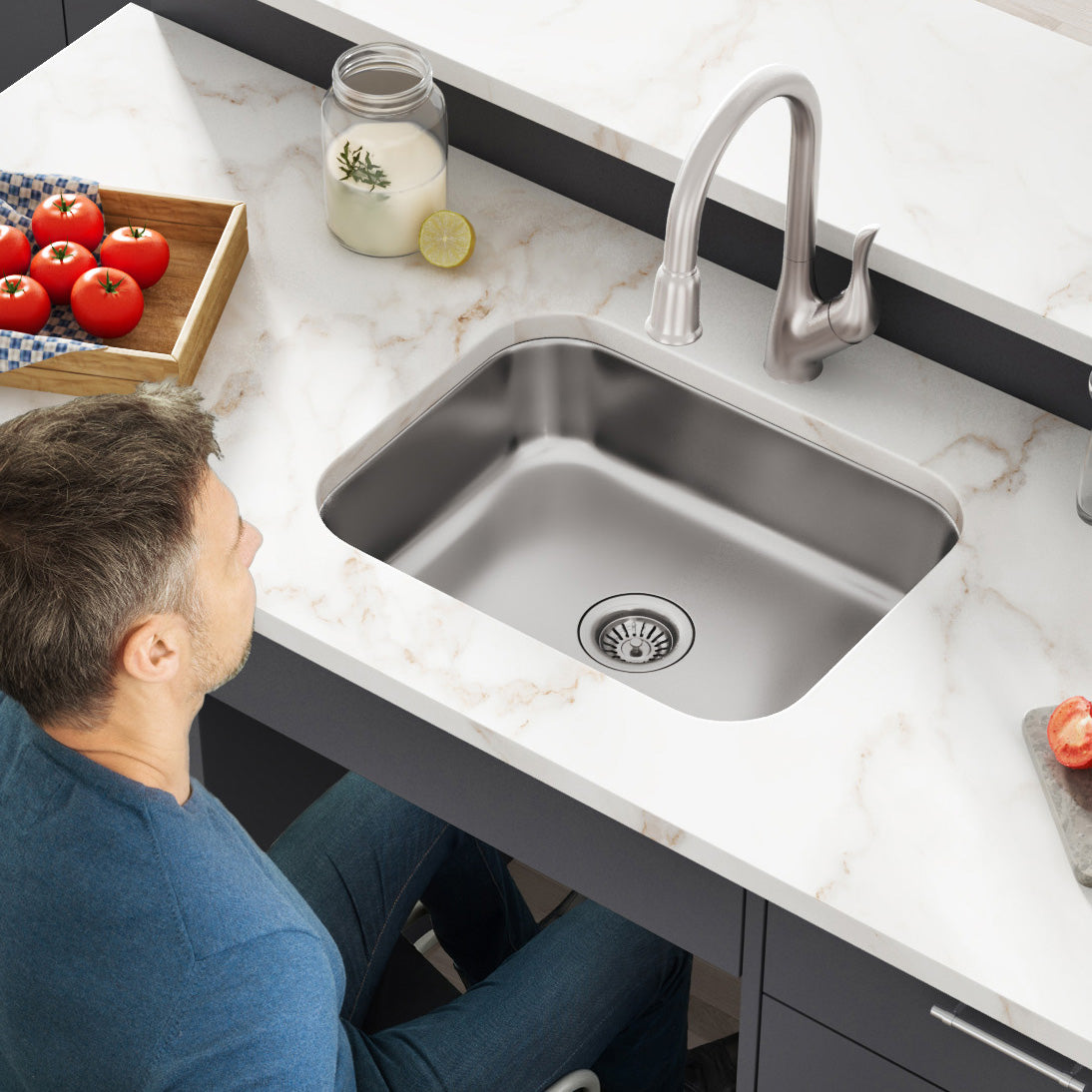
ADA-accessible kitchen sinks use the same width categories as standard sinks. The critical difference is basin depth. Standard kitchen sinks are typically 9"–10" deep. ADA-compatible sinks are significantly shallower — commonly around 5.5" for undermount installations — to preserve the knee clearance required below the counter.

The ideal standardization outcome: an ADA kitchen sink that shares the same outside width and cutout dimensions as the standard model. When achievable, this means one cutout template for the fabricator, regardless of unit type. The only difference is basin depth and drain configuration.
Drain configuration changes on ADA sinks. A standard center drain typically intrudes into the required knee clearance zone. ADA kitchen sinks need an offset or rear-set drain that routes plumbing toward the back wall.
If you're specifying kitchen sinks for a project with both standard and ADA units, aligning the sink width and cutout across both configurations at the specification stage simplifies fabrication and reduces field errors.
Multifamily Kitchen Sink Sizes: How to Standardize Across Units
Most multifamily projects need one standard kitchen sink size. For standard multifamily units with 33"–36" base cabinets, the 30" single-bowl undermount is the most commonly specified kitchen sink. It accommodates standard countertop depths and is available in both standard and ADA configurations from most commercial suppliers.
If the project has distinct unit tiers, a second size may be justified. Some Class A projects specify 33" sinks for premium units and 30" sinks for standard units. Beyond two sizes, every additional model adds procurement complexity, a cutout template, and a replacement SKU that the property manager inherits.
Compact units (studios, micro-units) may require 23" or 27" sinks to fit smaller cabinet layouts. These are the exception, not the base specification. If your project has a small number of compact units, adding a third sink size is acceptable — but verify the cutout template is available and the model will remain in production for replacement orders.

Sink sizing decisions should align with a standardized sink program to reduce long-term replacement complexity.
For a broader guide to kitchen fixture selection including faucet coordination and finish strategy, see Multifamily Kitchen Fixtures Guide: Sinks, Faucets, and ADA Basics.
Three Kitchen Sink Sizing Mistakes on Multifamily Projects
1. Using nominal size instead of actual dimensions. A "30-inch sink" is a nominal label. Actual outside dimensions vary by manufacturer. Always specify from the dimensional drawing, not the marketing name. A 0.25" discrepancy multiplied across 200 units is 200 potential cutout conflicts.
2. Specifying without verifying inside cabinet clearance. Cabinet face frames, plumbing, and disposal units reduce the available interior width. Measure the actual inside clearance — not the nominal cabinet size — before confirming the sink will fit.
3. Choosing a size that isn't available in an ADA variant. If your project has accessible units, the standard sink size you select must also be available in an ADA-depth configuration with the same outside dimensions. If it isn't, you're managing two cutout templates, two rough-in specs, and two replacement models.
Work with us
Access Project Pricing by Sink Size
Allora USA provides kitchen sinks in 23", 27", 30", and 33" configurations with matching ADA variants, cutout templates, and volume pricing for multifamily projects. Our team supports size standardization, phased delivery, and long-term replacement availability.
Questions? Call 571-291-3484