



Quick Reference
This guide covers five kitchen fixture areas for multifamily projects:
A multifamily kitchen fixtures guide is a specification resource that covers the coordinated selection of kitchen sinks, faucets, and ADA-compliant configurations for apartment, senior living, student housing, and hospitality construction projects.
Kitchen fixture decisions made during design cascade into countertop fabrication, cabinet layout, plumbing rough-in, and ADA compliance across every unit. When those decisions aren't coordinated, the errors compound—wrong cutout templates, incompatible faucet pairings, and accessible units that don't pass inspection.
This guide covers the fixture decisions that developers, architects, and property management companies need to get right before the kitchen spec leaves the drawing.
Kitchen Sink Selection for Multifamily Projects

Single bowl is the default for multifamily kitchens. Double-bowl sinks take up more cabinet space, are harder to use with large pots, and add installation complexity without meaningful resident benefit in most apartment layouts. Single-bowl sinks in the 27" to 33" range fit standard 30" and 36" base cabinets and cover the majority of multifamily floor plans.
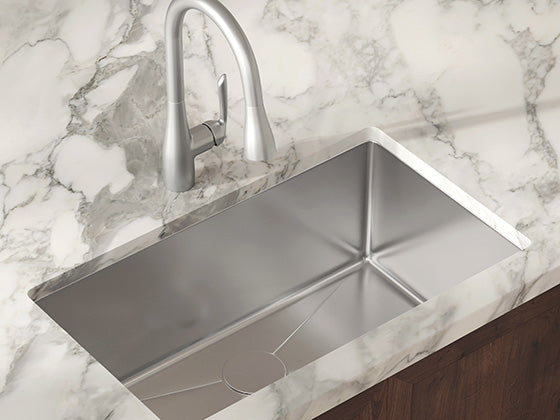
Undermount is the standard for new construction. No exposed rim, easier countertop cleaning, and a more finished look. Requires solid countertop material (stone, quartz, solid surface) and a manufacturer-provided cutout template. Top mount is acceptable for budget projects or laminate countertops where undermount isn't structurally supported.
Stainless steel dominates multifamily kitchen sinks. Lightweight for shipping and installation, durable under heavy use, compatible with every countertop material, and cost-effective at volume. PVD-coated finishes (matte black, gold, gunmetal) are increasingly specified for Class A projects where kitchen aesthetics drive lease-up velocity.
Gauge matters for durability. 16-gauge stainless steel is the standard for commercial and multifamily projects. 18-gauge is acceptable for budget-tier builds but dents more easily under heavy use. Anything thinner than 18-gauge is a replacement liability.
Browse undermount kitchen sinks and top-mount kitchen sinks to compare models by size, gauge, and configuration.
Kitchen Faucet Selection and Sink Coordination

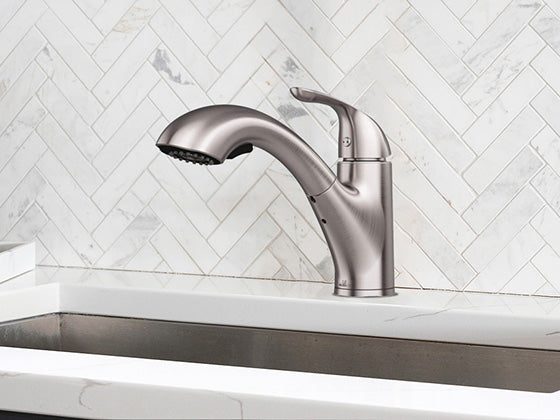
Single-hole, single-lever, pull-down sprayer. That's the configuration for most multifamily kitchens. It's the easiest to install at scale, the most intuitive for residents, and compatible with standard and ADA sinks. Two-handle faucets add installation time and create a scald risk in family units.
Hole configuration must match the sink. Undermount sinks typically have no pre-drilled holes—the faucet mounts through the countertop. Top-mount sinks may have 1, 2, 3, or 4 pre-drilled holes. Confirm the sink's hole count and spacing before specifying the faucet. This is the most common coordination failure on kitchen fixture installs.
Spout reach and height affect usability. The spout needs to reach the center of the basin, not the rim. Pull-down sprayers should have enough hose length to reach all corners of the sink. For ADA units, verify that the faucet controls are within the required reach range from a seated position.
Finish coordination across fixtures. On multifamily projects, the kitchen faucet finish should coordinate with cabinet hardware and bathroom fixtures. Standardizing on one or two finishes (chrome + brushed nickel, or chrome + matte black) simplifies procurement and maintains visual consistency across units.
See pull-down kitchen faucets for models designed for multifamily kitchen installations.
If you're coordinating sinks and faucets for a project with multiple unit types, aligning the pairing at the specification stage prevents compatibility conflicts and simplifies bulk procurement.
ADA Kitchen Fixture Requirements for Multifamily Projects

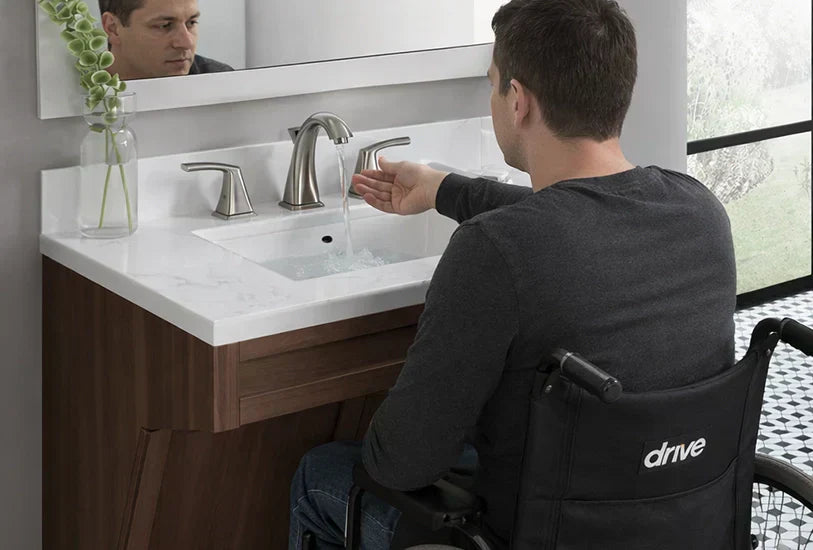
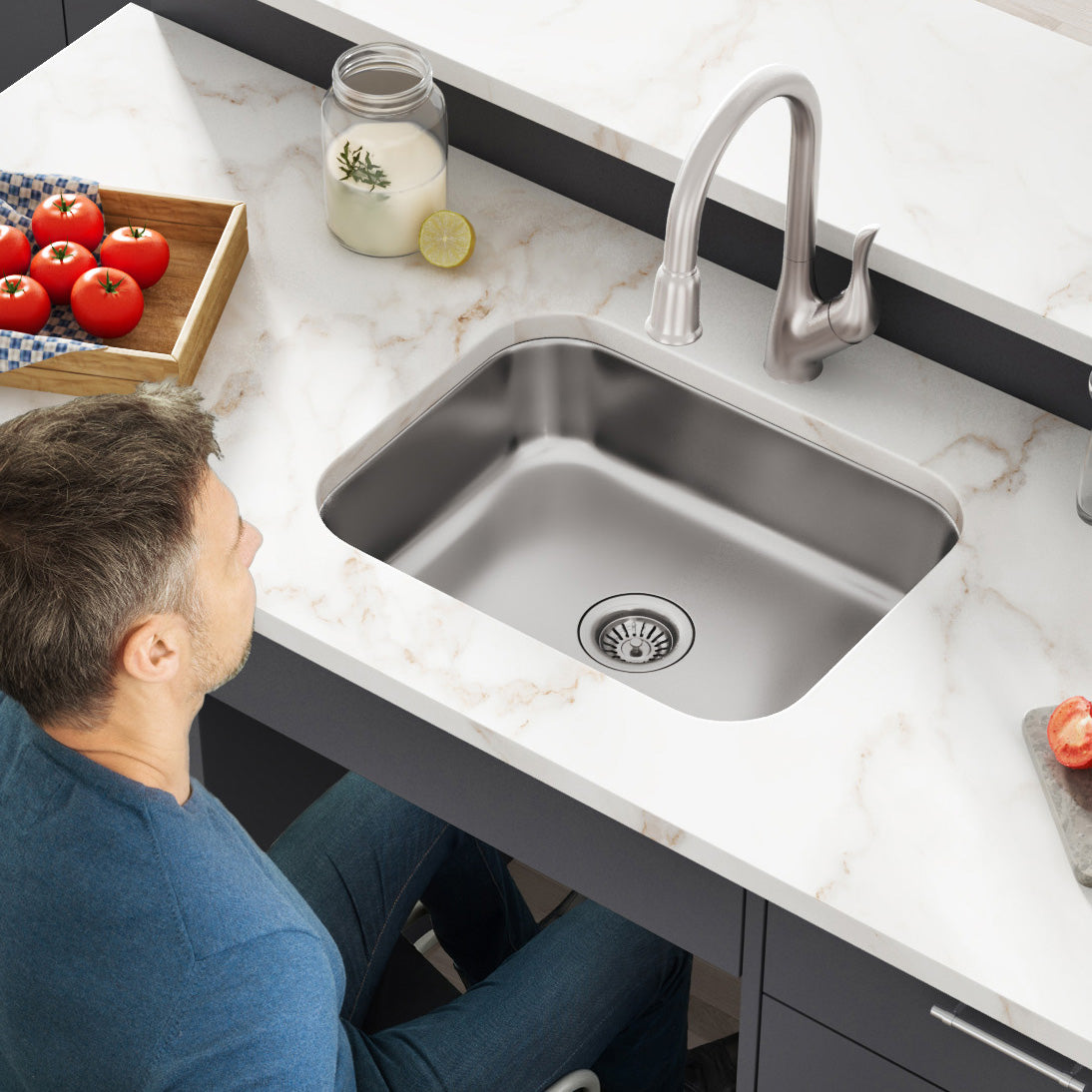
Accessible kitchen units have specific fixture requirements that differ from standard units. The ADA kitchen sink specification is tighter than the bathroom equivalent—basin depth is more constrained, drain configuration matters more, and the clearance geometry interacts with cabinet layout in ways that standard sinks don't.
Basin depth is the critical variable. Standard kitchen sinks are 9"–10" deep. ADA-compatible kitchen sinks are typically much shallower—commonly around 5.5" for undermount and 6.5"–7" for top mount—but the actual achievable depth depends on counter height, sink geometry, drain placement, and the resulting knee clearance. There is no single ADA code number for basin depth; the constraint is derived from the clearance dimensions below.
Drain configuration changes. A standard center drain won't work in most ADA kitchen sinks because the P-trap intrudes into the required knee space. ADA kitchen sinks need an offset or rear-set drain that routes plumbing toward the back wall, keeping the area below the sink open.
Faucet controls must be ADA-compliant. Single-lever operation, no more than 5 lbf activation force, no tight grasping or twisting. The same lever-style pull-down faucets used in standard units typically meet ADA requirements—but verify the reach range from a seated forward approach.
Key ADA Dimensions for Kitchen Sink Specification
| Requirement | Dimension | ADA Reference |
|---|---|---|
| Sink rim / counter height | 34" max from finished floor | §606.3 |
| Basin depth (undermount) | ≈5.5" (common design target) | Varies by geometry* |
| Basin depth (top mount) | ≈6.5"–7" (common design target) | Varies by geometry* |
| Knee clearance (H × W × D) | 27" × 30" × 11"–25" | §306.3 |
| Toe clearance | 9" high, 17" deep minimum | §306.2 |
| Clear floor space | 30" × 48" (forward approach) | §606.2 |
| Faucet operation | One hand, no tight grasp/pinch/twist | §309.4 |
| Faucet force | 5 lbf maximum | §309.4 |
| Exposed pipe protection | Insulated or covered | §606.5 |
| Drain configuration | Offset / rear-set (preserve knee space) | Best practice |
*Basin depth is not specified as a fixed maximum in the ADA Standards. The achievable depth depends on counter height, sink geometry, drain placement, and the resulting knee clearance below. The values shown are common design targets used by manufacturers to meet the clearance requirements in §306.
For full ADA kitchen design guidance including countertop heights, cabinet clearances, and appliance reach ranges, see ADA Kitchen Requirements Guide.
Kitchen Fixture Coordination by Project Type
Use this table to align kitchen sink and faucet selections to your project type. Each column maps the specification recommendations for the most common multifamily categories.
| Fixture Decision | Class A / Luxury | Workforce / Market Rate | Student Housing | Senior Living / ADA |
|---|---|---|---|---|
| Kitchen sink mount | Undermount | Undermount or top mount | Top mount | Undermount (ADA depth) |
| Kitchen sink material | Stainless steel or PVD | Stainless steel | Stainless steel | Stainless steel |
| Sink size | 30"–33" single bowl | 30" single bowl | 27"–30" single bowl | 27"–30" ADA single bowl |
| Basin depth | 9"–10" standard | 9" standard | 9" standard | 5.5" max (undermount ADA) |
| Faucet type | Single-hole pull-down | Single-hole pull-down | Single-hole pull-down | Single-lever, ADA-compliant |
| Faucet finish | PVD or brushed nickel | Chrome or brushed nickel | Chrome | Chrome or brushed nickel |
| Faucet-to-sink pairing | Coordinated spec set | Coordinated spec set | Standardized set | ADA-verified set |
| SKU target | 2–3 sink + 1–2 faucet | 1–2 sink + 1 faucet | 1 sink + 1 faucet | 1 std + 1 ADA sink + 1 faucet |
This table is a starting framework. Your project's specific unit mix, local code requirements, and budget constraints may shift individual cells. But if your current selections diverge significantly from the pattern above, that divergence is worth investigating before the fixture schedule is finalized.
SKU Standardization for Kitchen Fixtures

Target one kitchen sink model and one kitchen faucet model for all standard units. Add one ADA kitchen sink model for accessible units. If the ADA sink shares the same cutout dimensions as the standard model, the fabricator uses one template and the property manager stocks fewer replacement SKUs.
Pair the sink and faucet on the fixture schedule as a coordinated set. When they're specified separately—which happens constantly on multifamily projects—the pairing is where disconnects happen. Wrong hole count, incompatible reach, mismatched finish.
Verify reorder availability before specifying. The kitchen sink model you choose today needs to be available in five years when the first units turn over. A discontinued SKU forces the property manager to re-specify, re-template, and potentially re-fabricate countertops across every replacement unit.
Why Kitchen Fixture Coordination Fails on Multifamily Projects
The kitchen is the most fixture-dense room in a multifamily unit. Sink, faucet, countertop, cabinet—four interdependent components, often sourced from four different suppliers. That fragmentation is where specs break down.
Sink and faucet specified at different stages. The architect picks the sink in SD. The faucet gets specified in DD. By the time procurement issues the PO, the pairing hasn't been verified against the actual countertop and cabinet configuration.
ADA units treated as an afterthought. The standard kitchen gets fully specified. The ADA kitchen gets a last-minute substitution with a shallower sink that doesn't match the cutout template, the drain doesn't clear the knee space, and the faucet reach doesn't work from a seated position.
The fix: a supplier that provides the sink, faucet, and ADA variants as a coordinated package—with matching cutout templates, compatible rough-in specs, and volume pricing that holds through phased procurement. That's the infrastructure Allora USA provides through the Allora Advantage trade program.
Work with us
Access Project Pricing and Kitchen Fixture Support
Allora USA provides coordinated kitchen sink and faucet specifications, cutout templates, ADA documentation, and volume pricing for multifamily projects. We support phased delivery, SKU standardization, and long-term replacement planning for kitchen fixtures.
Questions? Call 571-291-3484